What Makes GESHA Coffee So Special?
May 29, 2026
Cinco Cielos Journal · May 2026 · 6 min read
If you've spent any time in the world of specialty coffee, you've probably heard the name GESHA whispered with a kind of reverence usually reserved for great wines or rare spirits. And if you haven't yet — you're in exactly the right place. We started Cinco Cielos with a single conviction: that one exceptional bean, grown with absolute care in the right place, is worth more than a hundred average ones. GESHA is that bean. And Colombia's Tolima mountains are that place.
Let's take a proper look at why GESHA has taken the coffee world by storm, what makes it fundamentally different from anything else in your cup, and why — when you understand where it comes from and how it grows — a bag of Cinco Cielos GESHA starts to feel less like a purchase and more like an encounter.
The Origins of GESHA: A Bean with a History
GESHA (sometimes spelled Geisha) traces its roots to a small village called Gesha in the forested highlands of southwestern Ethiopia — one of the very birthplaces of coffee on Earth. For decades, the variety was largely overlooked. It grew slowly, yielded less fruit than commercial varieties, and demanded more from the land and the farmer. By conventional agriculture's logic, it simply wasn't efficient.
That changed in 2004, when a lot of GESHA from Hacienda La Esmeralda in Panama entered the Best of Panama competition and stunned every judge in the room. It scored higher than any coffee in the competition's history. The flavor profile was unlike anything the panel had tasted: floral, tea-like, luminously complex — a coffee that seemed to break the rules of what coffee was supposed to be. It sold at auction for a price that made headlines worldwide. And the specialty coffee world has never looked back.
"GESHA didn't just win a competition. It rewrote what judges and drinkers believed coffee could taste like — and it's been doing so ever since."
— Cinco Cielos, TolimaWhat Makes GESHA Taste So Different?
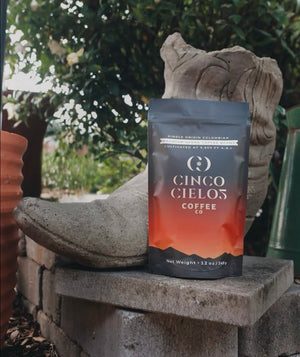
Most coffee varieties — even good ones — share a recognizable family resemblance. You know you're drinking coffee. GESHA politely ignores that convention. At its finest, it behaves more like a complex white tea or a floral infusion than a traditional brew. The acidity is bright but never harsh. The body is silky and light. And layered beneath, you'll find tasting notes that shouldn't logically exist in a cup of coffee: jasmine, bergamot, peach — and in our Cinco Cielos expression, warm hazelnut, vibrant cranberry, and a long finish of dark chocolate.
This complexity is not a matter of roasting technique or processing wizardry. It is genetic. The GESHA variety produces a chemically distinct profile of aromatic compounds that no other widely-grown variety replicates. You can't engineer it. You can only coax it out of the right environment, with the right hands.
Why GESHA Keeps Winning — Everywhere
Since that 2004 breakthrough in Panama, GESHA has dominated specialty coffee competitions on nearly every continent. Blind cupping panels — composed of the most experienced palates in the industry — return to it again and again. Why? Because GESHA is genuinely difficult to grow well, which means the farmers who commit to it are, by definition, the most serious ones in the room. It rewards patience and punishes shortcuts. When it's done right, what arrives in your cup is the result of an unbroken chain of good decisions, from seed to harvest to your hands.
At Cinco Cielos, that chain is everything. It is the only product we grow. We don't divide our attention.
Colombia's Secret Advantage: Altitude and the Gift of No Seasons
Colombia is one of the very few coffee-growing countries on earth that harvests year-round. Most major producers are governed by a single main harvest season — one shot per year. Colombia, uniquely, operates on a bimodal rainfall pattern — two distinct rainy and dry cycles — which creates two harvest windows annually. For GESHA, this is extraordinary. The bean has more time to develop. Farmers have more opportunities to observe, adjust, and perfect their approach. Consistency of climate produces consistency of quality — and consistency, compounded over harvests, produces excellence.
⛰ Why Colombia's Altitude Changes Everything
- — Slower bean development: At 1,500–2,000 metres above sea level, cooler temperatures slow the maturation of the coffee cherry. The bean spends more time developing its sugars and aromatic compounds — producing greater depth of flavour.
- — Higher density: High-altitude beans are physically denser — a direct marker of quality. They hold more soluble flavour compounds and respond better to roasting.
- — Natural pest resistance: At altitude, the coffee borer beetle cannot thrive — keeping the growing process as natural as possible.
- — Clean, mineral-rich water: Tolima's mountain range feeds our farm with glacier-influenced water. Coffee cherries absorb water throughout their growth — what goes in shapes what comes out.
- — Dramatic diurnal range: The swing between warm days and cool nights locks in sugars and intensifies the fruit-forward, floral notes that define great GESHA.
Tolima: Colombia's Rising Star
While Colombia's coffee reputation has historically been anchored in regions like Huila and Nariño, Tolima has been quietly building a case for itself as the country's most exciting frontier for specialty coffee. Nestled between the Central and Eastern Andes ranges, Tolima's farms sit at altitudes perfectly calibrated for GESHA's demanding nature. The soils are volcanic, mineral-rich, and well-drained. It is no coincidence that our Cinco Cielos GESHA claimed the #1 prize in Tolima 2024. We chose this land deliberately — not because it was convenient, but because we understood what it could do for this variety.
"Great coffee is not manufactured. It is grown slowly, at altitude, in soil that has earned it — and then simply respected all the way to your cup."
— Cinco Cielos PhilosophySo — Should You Try GESHA?
If you're reading this, you already suspect the answer. GESHA is not a novelty or a marketing exercise. It is the product of a specific plant, in a specific place, cared for with a specific level of commitment — and when all of those things align, the cup is genuinely unlike anything else available to coffee drinkers today.
We recommend brewing Cinco Cielos GESHA with a ratio of 1g of coffee to 15ml of water, using whatever method you love most. Give it clean water, proper temperature, and a little patience — and it will return the favour in full.
This is our first blog post, and we could not imagine beginning anywhere else. GESHA is why Cinco Cielos exists. Welcome to the farm. We're glad you're here.
The Cinco Cielos Team
Tolima, Colombia · Est. 2024